Abstract
In today’s demanding work environment, achieving genuine well-being requires a holistic approach that integrates personal habits with scientific insight. This article explores a transformative path to resilience by introducing the daily practice of the “Compassionate Commute”—a simple ritual of empathetic connection that fosters immediate calm. It reframes stress as a potential ally, distinguishing between performance-enhancing challenge stressors and energy-draining hindrance stressors. Drawing from diverse fields, the article synthesises lessons from longevity-rich Blue Zones, the neurochemistry of happiness, and the cognitive reappraisal of limiting beliefs. It culminates with an evolved understanding of the Job Demands-Resources (JD-R) theory, arguing that the most critical resource for modern professionals is their capacity for continuous learning and adaptation. By consciously nurturing physical, mental, emotional, social, and spiritual dimensions, we can build a sustainable foundation for well-being that turns pressure into growth and fosters a more fulfilling professional and personal life.
Before we begin, let’s try a small exercise I practice every day.
I call it the Compassionate Commute. Whether I’m on a bus, in the metro, or even visiting a temple, I pause to notice the people around me. Each of them carries hopes, worries, and quiet prayers. For a few moments, I silently add my own wish for their happiness: that their burdens lighten, their wishes come true, that their day becomes a little easier. I make it a habit to stand, allowing others to sit and be comfortable.
This simple habit fills me with unexpected warmth—sometimes I literally feel it in my hands—along with a deep sense of calm. Even now, as I write these lines, I can feel the warmth in my fingers and the joy in my heartbeat.
Introduction – The Whole Picture of Well-Being
Holistic well-being views life as an interconnected web. Our physical, mental, emotional, spiritual, and social dimensions don’t stand alone; what happens in one inevitably ripples into the others.
Take a simple example: a lingering back pain. At first, it’s purely physical, but the discomfort can disturb sleep, drain patience, and trigger frustration or sadness. Soon, emotional energy dips, social interactions feel harder, and even mental focus at work suffers. One strain spreads across the entire system.
Let’s explore how each dimension can be nurtured to build a more balanced, resilient life.
1. Stress is Good!
Stress is often treated as the villain of modern work life, yet research shows it can also be a performance booster. The key is knowing the difference between two kinds of pressure:
- Challenge stressors—tight deadlines, critical presentations, ambitious targets. These sharpen focus and can lift engagement and results.
- Hindrance stressors—office politics, unclear responsibilities, unnecessary red tape. These sap energy and morale.
That’s why preparing for a board presentation can feel energising, while chasing endless approvals feels draining.
The positive side of pressure is known as eustress (from the Greek eu, meaning “good”). Athletes before a big match, sales teams closing a major deal, or project leaders hitting a launch date all draw on this surge. A moderate level of stress heightens alertness and fuels top performance, too little breeds complacency, too much leads to burnout.
Managed well, stress becomes a strategic ally in both productivity and growth.
1. The Biochemicals of Well-Being
The art of well-being is incomplete without its science. Our moods and sense of balance are guided by a remarkable set of natural chemicals. By choosing activities that spark these “feel-good” messengers, we can give our well-being a daily boost.
- Dopamine – The Reward Molecule:
- That spark of excitement before a holiday or a long-awaited success? Dopamine fuels the anticipation and motivates us to keep reaching for goals.
- Oxytocin – The Bonding Molecule:
- Shared laughter with friends, a warm family dinner, or genuine teamwork at the office releases oxytocin, deepening trust and connection.
- Endorphins – The Pain-Killing Molecule:
- A brisk walk, a challenging workout, or even a hearty laugh triggers endorphins, easing discomfort and lifting mood—proof of the classic “no pain, no gain.”
- Serotonin – The Confidence or self-esteem molecule:
- Taking on a tough project, giving our best effort, and succeeding boosts serotonin, bringing calm confidence and a sense of achievement.
Knowing how these natural chemicals work lets us design days that nourish body and mind—whether that’s a team workout, a mindful break, or celebrating a win together.
1. Blue Zones – Lessons in Longevity and Well-Being
Longevity and holistic well-being go hand in hand. Blue Zones—regions like Okinawa (Japan) and Sardinia (Italy)—are home to people who regularly live past 100. Their lifestyle offers valuable lessons for enriching our own well-being:
1. Natural Movement:
2. Residents don’t hit the gym intentionally. Their daily routines—gardening, walking, climbing stairs—naturally keep them active with moderate exercise throughout the day.
3. Diet:
4. Diets are largely plant-based (around 95%), and meals are taken on small plates, often sitting on the floor. Simple habits like bending to eat and using smaller portions signal the body to moderate calorie intake.
5. Stress Reduction:
6. One day a week is devoted to slow nature walks and reflection, which helps reverse inflammatory responses in the body—a strong marker of both happiness and health.
7. Life Purpose – Ikigai:
8. Having a clear reason to live, or ikigai, gives every effort meaning. When life has purpose, striving feels natural, not stressful.
9. Pro-Social Engagement:
10. Strong bonds with family and friends create security and well-being. Social connection stimulates the vagus nerve, promoting relaxation, and improves heart rate variability—a central indicator of long-term health.
By adopting even a few of these practices, we can enrich not just our lifespan but also the quality of our daily life and holistic well-being.
1. Mental Templates: Limiting Beliefs and Cognitive Reappraisal
From childhood, we develop mental “templates” or frames—beliefs about ourselves and the world—that shape how we think, feel, and act. Over time, some of these become limiting beliefs, subtly undermining our well-being. For instance, we might feel overlooked because of our background or doubt our capabilities. These patterns can fuel pessimism and reduce resilience.
Cognitive reappraisal is a powerful tool to counteract this. It involves consciously reframing our thoughts to create a more balanced, constructive perspective:
1. “Life is not fair.”
2. Reappraisal: Life is good at times and challenging too. Challenges and joys are both part of life’s natural rhythm. My task is to adapt and move forward.
3. “People are selfish.”
4. Reappraisal: Adam Smith’s “Invisible Hand” theory reminds us that societal good often emerges from individual pursuits. The baker provides bread not out of pure charity, but to earn a living. Healthy self-interest is a natural part of human interaction and can drive collective benefits.
5. “I am not good enough.”
6. Reappraisal: I am good in some areas and average in others. I am a work in progress and working towards improving myself in my deficit areas.
By consciously reappraising limiting beliefs, we can shift our mindset from pessimism to resilience, enhancing both personal well-being and professional performance.
1. Gratitude
When we focus on the good things people do for us and cultivate genuine gratitude, it does not erase the life’s challenges we face, but it broadens our perspective, reminding us that our miseries do exist, but they are not the entirety of our lives. Gratitude helps us experience more positive emotions, savour meaningful moments, and even supports better overall health.
A Final Door to Well-Being…
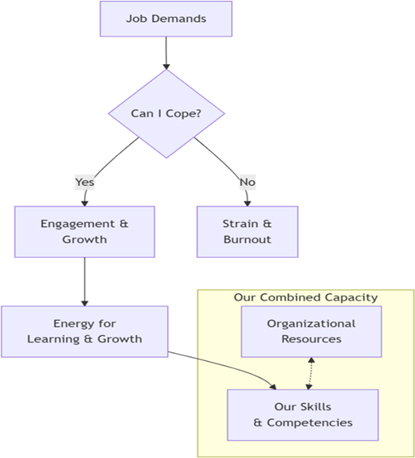
Before concluding, there’s one more key to holistic well-being: the Job Demands–Resources (JD-R) theory.
It explains how work-related demands and personal resources must stay in balance; we can extend the idea to life as a whole.
When job demands rise, we draw on our personal resources. If those two sides fall out of balance, dissonance, unhappiness, and dissatisfaction can follow, undermining our well-being.
The most critical resource we can cultivate is our own ability to adapt and grow. When new challenges arise, we don’t just draw on static resources—we must draw on our capacity to learn.
This balance is achieved by consciously nurturing our inner resources across five key dimensions