
Mohit Goel, IOCL, Naveli Singh, IOCL
goelmohit@indianoil.in, singhn8@indianoil.in
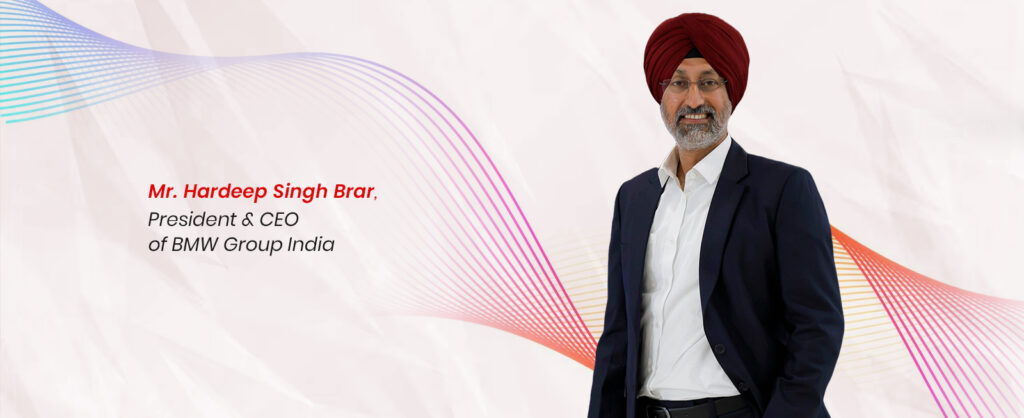
With over three decades of leadership across some of the world’s most respected automotive brands, Mr. Hardeep Singh Brar brings a rare blend of strategic depth, cultural fluency and people-centric leadership to his role as President & CEO of BMW Group India.
A mechanical engineering graduate from Thapar Institute of Engineering and Technology and an alumnus of Harvard Business School’s Senior Executive Leadership Program, Mr. Brar’s career has spanned some of the most iconic names in the industry, including Maruti Suzuki, Volkswagen Passenger Cars, General Motors, Nissan Motor, Great Wall Motor Company and Kia India — where he most recently served as Senior Vice President of Sales and Marketing. Under his stewardship, BMW’s vision in India is not just about performance and product excellence but about driving culture, people capability and organisational resilience in a landscape defined by rapid change.
In conversation with Mr. Mohit Goel and Ms. Naveli Singh.
In September 2025, Mr. Brar took charge as the President and Chief Executive Officer of BMW Group India, stepping into the leadership of one of the most dynamic markets for the luxury automotive segment, and tasked with guiding the company through shifting consumer expectations, technological innovation and strategic growth
Before we speak about leadership in organisations, let us begin with the person behind the role. What early influences, at home or in life, quietly shaped the leader you have become?
I was fortunate to grow up with three very different role models at home. My grandfather led through inspiration. My father, though busy, quietly observed and tracked my overall progress. My mother, a schoolteacher, was very hands-on, especially in my early years, making sure I stayed disciplined and finished what I started.
Each of them represented a different leadership style. Had my influences been uniform, my perspective may have been singular. Instead, by gathering fragments from each – like motivation, trust and discipline, I built a more nuanced internal compass. That blend helped me become more balanced, more understanding of people, and more adaptable as a leader.
In many ways, that diversity at home prepared me for the diversity I would later encounter in the corporate world.
Later in life, my wife has been an equally important influence, often my mentor and sounding board. With her own rich corporate experience, especially in HR, she brings a sharp people perspective that helps me navigate complex situations, refine decisions and stay grounded in the human side of leadership.
You have led across geographies, companies and cultures. How has this global journey shaped the way you express leadership today?
I have been fortunate that my career has been a masterclass in cultural translation, shaped by leadership roles within the precision of Japanese giants like Suzuki and Nissan, the industrial scale of General Motors, the rapid-fire ambition of China’s Great Wall Motor, and the storied engineering legacies of Volkswagen, Kia and now BMW. Global leadership has taught me that authority is a language spoken in many dialects. I have seen first-hand how the exact same behaviour can be decoded in polar opposite ways. For instance, in some parts of the world, being expressive is mistaken for arrogance, while in others, being quiet is read as uncertainty. In some cultures, hierarchy is revered and in others, openness defines credibility.
Ultimately, I have learned that effective leadership isn’t measured by the intent of the speaker, but by the resonance of the message. To lead across borders, you must do more than just communicate. You must calibrate and every challenge issued and every word spoken must be tuned to the cultural frequency of the room.
Looking back, what has been the most important shift in how you personally lead people today compared to earlier in your career?
Earlier in my career, I was intensely focused on content and detail. I wanted to push the agenda, drive the subject, solve every problem. Over time, I realized something far more powerful: Leadership is not only about empowering people but also about lighting a fire in them. When people feel heard, trusted and connected to their leader, they don’t need to be pushed. They begin to move on their own.
Today, I see leadership as an act of belief, the act to believing in people so strongly that they begin to believe in themselves.
In your view, what really brings out the best in people at work and how does emotional intelligence play a role in that?
I believe in a simple truth. Everyone who walks into an organization wants to matter. Nobody comes to work hoping to fail. When you start with that belief, everything changes.
If you are always searching for what is wrong, you drain energy from the system. But if you trust people, you release energy. Of course, not everyone needs the same style of leadership. Some people are highly self-driven and you simply need to motivate and support them. Others may have rough edges and need coaching. Some may even require more structured guidance.
We often obsess over numbers and execution. Yet it is the softer skills like empathy, patience, and the ability to listen that unlocks real performance. I think, as individuals, we need to work on our inner self. Once you master your inner self, your outer world begins to fall into place.
I have seen this time and again that under some leaders, people feel constrained and underperform. But the same people flourish under others. The difference is rarely competence but their emotional climate.
In high-stakes industries like Automotive and Oil & Gas, leaders must balance safety with innovation. For a brand like BMW which stands for innovation and performance, how do you ensure that people feel safe to experiment?
Trust is the bridge between safety and innovation. When people do not feel trusted, they play safe. They avoid risk. And an organization that avoids risk slowly stops growing.
When people are trusted, mistakes will happen, but so will breakthroughs. What matters is intent. Was someone careless, or were they courageous? Culture helps you tell the difference.
A culture that allows people to fail fast, learn and improve creates extraordinary commitment. People go the extra mile when they know they will not be punished for trying. When culture is right, many of the organization’s problems quietly disappear.
How did your experience at Harvard Business School leadership program shape the way you think about leadership and decision making?
The biggest lesson was perspective. Sitting with people from different functions, industries and countries, I realized how narrow my own viewpoint could possibly be. Though, the same problem looked completely different from another person’s eyes.
That experience trained me to think not as a function, but as an organization. It reminded me that leadership is not about having all the answers but about being open to better questions. The case studies, covering both successes and failures, further reinforced that learning. And beyond that, the alumni network continues to be a powerful source of insight.
Today’s workplace brings together multiple generations with very different expectations. How do you build a culture where all of them feel aligned, valued and engaged?
We understand that the younger generation is very clear about what they want. Purpose and content matter deeply to them. Unlike earlier generations, who often worked things out regardless of whether they enjoyed it, today’s workforce wants meaning.
At BMW, we give people flexibility. We trust people to be responsible. Our culture is highly collaborative, and that collaboration is reinforced even in how people are evaluated. Leadership here is about how you work with others, not just what you deliver.
Even our appraisal system reflects this philosophy. People are evaluated not only on performance, which is assessed by their manager, but also on leadership—how they work with others across the organization. This leadership dimension is shaped by feedback from multiple stakeholders who interact with them, ensuring that success is not defined solely by individual achievement, but also by how effectively one contributes to the collective.
Over time, people learn a delicate but powerful skill, how to say no to work without offending people. That ability to be rational, respectful and clear is what makes teams truly effective.
BMW is often described as having a very strong and uniform culture. How do people truly absorb and live this culture once they join?
Our belief is that talent shines brightest when it stands on values.
Culture is not taught, it is felt. Our values live in everyday behaviour. New people learn not from manuals, but from moments. From how people speak, listen and decide.
A strong culture takes years to build, but when it takes root, it becomes unstoppable. At BMW, it is not one leader who defines it, it is everyone.
What do you believe enables people to stay healthy, motivated and resilient in demanding work environments?
We believe openness is the greatest wellness policy. Anyone can walk into my office or speak to HR or leadership. There is no hierarchy in access. Stress often arises when people feel trapped, when they don’t know where to take their concerns. At BMW, people always have somewhere to go without fear.
We choose trust over pressure, and motivation over monitoring. When people feel safe, they bring their best selves to work.
In the end, what stays with an organization is not just what it achieves, but what people felt while achieving it. When the culture is right, everything else begins to fall into place.
Posted in Leader Speaks | No Comments »
View Next Articles

Recent Articles
- Happiness is a Serious Business
- Life is simple, and humour is a constant reminder of that simplicity!
- Engineering a culture of trust
- Never let success get to your head and never let failure get to your heart!
- Diversity is about synergizing the unique abilities of each individual and achieving a common purpose!
- A Road to Dignity
- Pandemic provided the tailwind to HR technology sector
- Make your workplace feel like home!
- Promoting mental health at workplaces in India
- The man who moved the mountain!
- CSR beyond Compliance: Its the intent that matters!
- Be curious enough to move up the value chain!